Why self-assessment is not enough on its own
Self-report and observer report are two perspectives on the same person. Here is what agreement and disagreement can tell us – without turning either view into the truth.
In this article
The same person, seen from different positions
We know things about ourselves that other people cannot see: our intentions, doubts, and the background to a situation. Colleagues, on the other hand, observe how we behave with them in everyday work. These two sources of information overlap, but they are not identical.
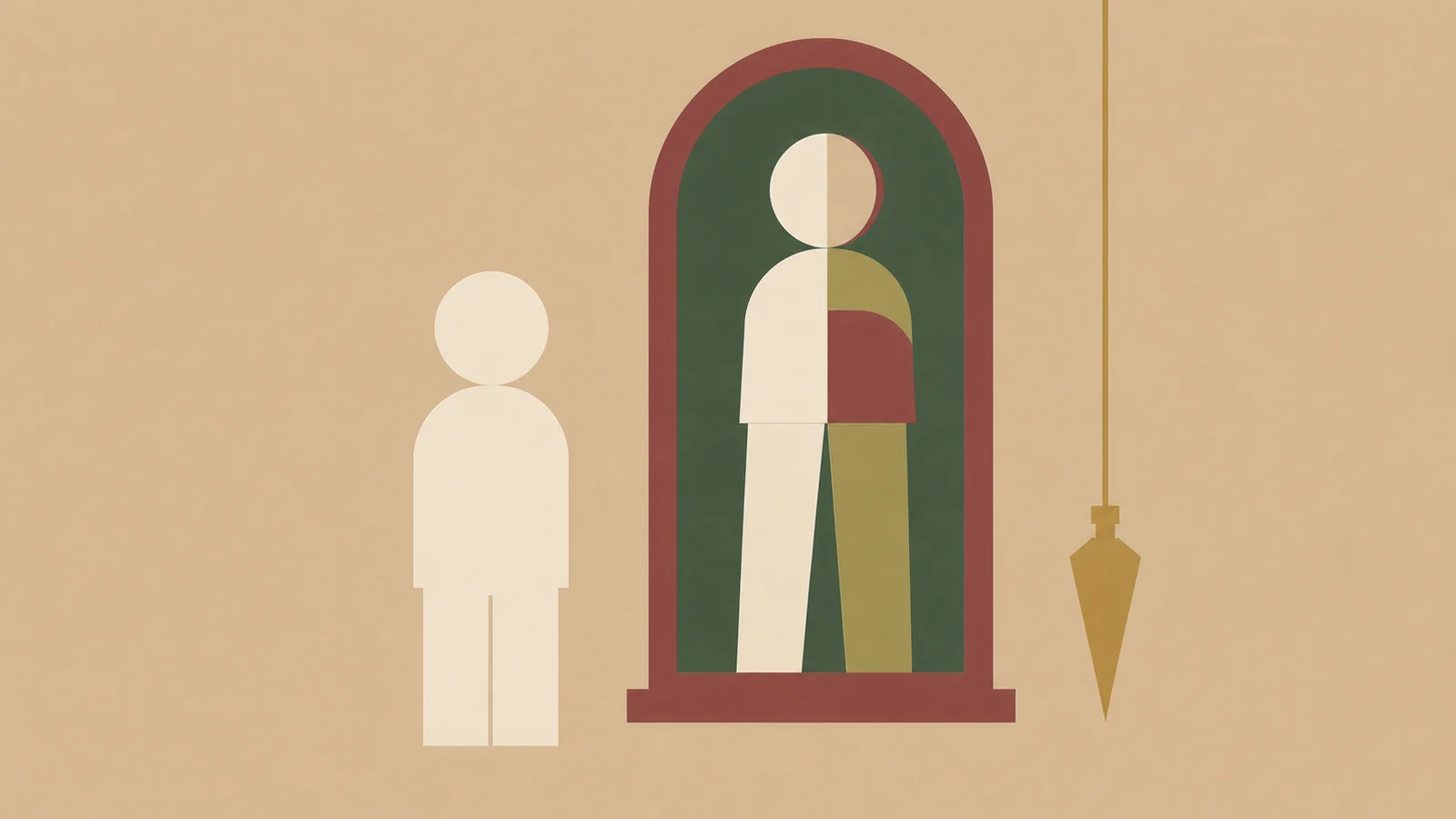
Self-report and observer report are not a true–false pair. They describe the same person from positions with access to different information.
Agreement depends on the trait being assessed, the questionnaire, the observer's relationship to the person, and how well they know each other. A single universal correlation therefore gives a misleadingly simple picture.
A difference is not automatically a bias
A large meta-analysis found no general self-enhancement effect across personality traits. The direction and size of a difference can vary by dimension, relationship, and sample. It is therefore not defensible to claim that people generally overrate their CConscientiousness, or that a low HHonesty–Humility score implies self-enhancement.
In the standard HEXACO model, EEmotionality is also not simply the reverse of Big Five emotional stability. Interpretation must start from the actual content of the scale being used.
Why can the two views differ?
They cover different situations. We know ourselves across many contexts; a colleague mainly rates the behaviour they have seen in shared work.
Some traits are easier to observe. Social signals of XExtraversion are relatively visible, while anxiety, intentions, and private deliberation are less accessible to an observer.
Measurement is uncertain. Item interpretation, response style, relationship quality, and the current context can all influence a score.
An ideal self may appear in responses. People may sometimes answer partly in line with who they want to be. This does not affect everyone, every trait, or every situation in the same direction.
What do two perspectives add?
A gap is not a verdict. It is a signal that needs interpretation: where does it appear, and what concrete behavioural evidence sits behind it?
Observer feedback adds value when it is not used for labelling. A larger difference can open useful questions: do we see each other in different situations? Are expectations unclear? Is there a contribution that feels important internally but is less visible to others?
How trita uses the comparison
trita does not decide who is right or describe either perspective as the more “realistic” one. It presents the difference as a prompt for discussion. At team level, interpretation requires concrete examples, multiple sources of evidence, and – in sensitive situations – a trained facilitator.
Sources and limitations
- Kim et al.: meta-analysis of mean self–observer differences
- Connelly and Ones: observer-rating accuracy and incremental validity
- Lee, de Vries and Ashton: HEXACO self–observer agreement across relationships
- Official HEXACO scale descriptions
These studies concern personality models and several established instruments. They do not automatically validate trita's item selection, wording, scoring, or report interpretations.
Try it
See what your results look like.
In ~10 minutes, get a useful picture of what you bring to a team — for free.
Értesítő
Új cikkek és ritka, válogatott összefoglalók
Minden új blogbejegyzésről értesítünk, és időnként több cikkből álló szerkesztett hírlevelet küldünk. Bármikor leiratkozhatsz.